UCL Table Decoded: The Ultimate Breakdown of Knockout Stage Qualifications
The famous anthem plays, the floodlights beam down, and the world’s best players take the pitch. But this year, something is different. The familiar comfort of the four-team group stage is gone, replaced by a massive, monolithic league table that has turned the UEFA Champions League (UCL) on its head. If you are looking at the standings and feeling a mix of excitement and confusion, you are not alone.
The introduction of the League Phase has fundamentally altered the mathematics of European glory. Every goal scored, every draw salvaged, and every disciplinary point now feeds into a single, high-stakes table involving 36 teams. The margin for error has never been slimmer, and the rewards for consistency have never been higher.
Understanding the UCL table is no longer just about checking who is top of Group A or B. It is about analyzing a complex ladder where position 8 and position 9 are separated by a razor-thin margin that dictates the entire future of a club’s campaign. In this comprehensive breakdown, we will decode the qualification criteria, the tie-breakers, and the strategic nuances of the new knockout stage qualifications.
The New Era: One Table to Rule Them All
Gone is the era of the ‘Group of Death’ where three giants battled for two spots. Under the new Swiss Model inspired format, all 36 participating clubs are ranked in a single league table. Each team plays eight matches against eight different opponents—four at home and four away. This asymmetry adds a layer of complexity that never existed before.
In the old format, you knew exactly what you needed to do against your three group rivals. Now, your fate is intertwined with teams you might not even play against. A result in a match between Real Madrid and Liverpool affects the standing of AC Milan or Borussia Dortmund. This interconnectivity means the table remains fluid until the final whistle of Matchday 8.
The primary objective is simple: accumulate as many points as possible. However, the implications of your final finishing position are tiered in a way that creates three distinct battles within the single table.
The Golden Ticket: Finishing in the Top 8
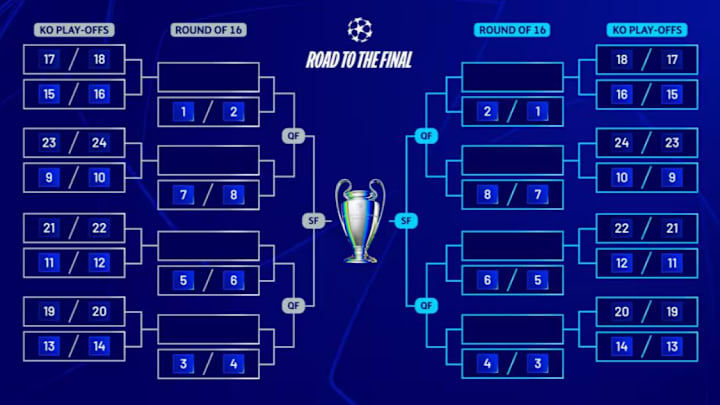
The most coveted real estate in European football right now is the top eight positions of the UCL table. Finishing in this zone is not just about prestige; it provides a massive tactical advantage for the remainder of the tournament.
- Rest and Recovery: These teams skip the arduous two-legged knockout phase play-offs scheduled for February. In a congested modern calendar, avoiding two high-intensity matches is a massive physical advantage.
- Seeding Status: By finishing in the top 8, clubs are seeded for the Round of 16 draw, ensuring they face unseeded opponents (the winners of the play-offs).
- Home Advantage: These teams generally earn the right to play the second leg of the Round of 16 at home, a factor that historically boosts progression rates.
The race for the 8th spot is often the most dramatic narrative of the League Phase. The difference between finishing 8th and 9th is the difference between a direct ticket to the business end of the tournament and a dangerous detour through the play-offs.
The Battleground: Positions 9th to 24th
If a team fails to crack the top eight, their Champions League dream is not over, but it certainly becomes more difficult. Teams finishing from 9th to 24th enter the Knockout Phase Play-offs. This is essentially a preliminary knockout round introduced to whittle the field down before the Round of 16.
Seeded vs. Unseeded Play-off Teams
The teams finishing between 9th and 16th are seeded for the play-off draw. This means they will face the teams that finished between 17th and 24th. Furthermore, the seeded teams have the advantage of playing the second leg at home.
For the giants of Europe who stumble early in the season, securing at least a 9th-16th finish is mandatory to ensure a slightly more favorable path. Falling into the 17th-24th bracket means facing a tougher opponent and playing the decisive second leg away from home—a recipe for an upset.
The Danger Zone: Immediate Elimination
Perhaps the most ruthless change in the new format is the removal of the safety net. In previous years, finishing third in a UCL group meant a transfer to the UEFA Europa League. That consolation prize has been abolished.
This raises the stakes immensely for the ‘smaller’ clubs. Previously, a few good results might secure a Europa League spot. Now, they must fight tooth and nail to scrape into that 24th position just to keep their continental journey alive.
Decoding the Tie-Breakers
With 36 teams in a single league, the probability of teams finishing level on points is incredibly high. It is almost a statistical certainty that multiple clubs will be tied at the boundaries of the Top 8 or the Top 24. Understanding the tie-breaker rules is essential for predicting qualification.
- Goal Difference: The superior goal difference in the league phase is the primary differentiator. This encourages teams to keep attacking even when winning comfortably.
- Goals Scored: If goal difference is equal, the team that has scored the most goals takes precedence.
- Away Goals Scored: The number of goals scored away from home is the third criteria.
- Wins: The total number of wins in the league phase.
- Away Wins: The number of wins obtained away from home.
If teams are still inseparable after these sporting criteria, the system reverts to the strength of schedule. This is a unique feature of the Swiss Model. The tie is broken by calculating the total points obtained collectively by the opponents a team has faced. Effectively, if you gained your points against stronger opposition, you are ranked higher.
Strategic Implications for Managers
This breakdown of qualifications forces managers to adapt their strategies in real-time. In the old format, a team might secure qualification after Matchday 4 and field a reserve team for the final two games. In the new League Phase, every goal counts toward the final ranking.
A manager whose team is sitting comfortably in 5th place cannot afford to coast. Dropping to 9th means playing two extra games. Conversely, a team in 20th place might throw everyone forward in the dying minutes of a match, knowing that a single goal could improve their goal difference enough to jump into the seeded 9-16 bracket.
We are likely to see fewer ‘dead rubber’ matches. Even in the final minutes of Matchday 8, teams will be chasing goals to improve their seeding or avoid the drop zone. The concept of ‘game management’ shifts from holding onto a 1-0 lead to potentially chasing a 3-0 win to secure a tie-breaker advantage.
Conclusion: Every Match Matters
The new UCL table format has successfully injected urgency into every stage of the competition. The breakdown is clear: The Top 8 is the VIP lounge, the 9th-24th zone is the chaotic waiting room, and anything below 25th is an abrupt exit.
As we watch the table fluctuate with every goal scored across Europe, remember that the complexity serves a purpose. It ensures that the giants cannot sleepwalk through the autumn, and the underdogs have a tangible target to aim for. Whether you are fighting for the title or fighting for survival, in this new system, every single point, goal, and tackle contributes to the final verdict.

Anatoliy Trubin: Is Benfica’s Young Shot-Stopper Destined for Stardom?

Benfica vs. Real Madrid: A Clash of Titans, A Legacy of Legends
Champions League Bracket: Unveiling the Road to Glory in the Knockout Stages
About The Author
