The Champions League Revolution: Understanding the New Playoff Format and Its Massive Implications
The iconic anthem begins, the starball banner waves in the center circle, and the floodlights beam down on the pitch. For decades, football fans knew exactly what came next: eight groups, four teams each, and a straightforward path to the knockout stages. But as of the 2024/25 season, that familiarity has been shattered. The UEFA Champions League has entered a new era, bringing with it the most significant format changes since the competition’s rebranding in 1992.
This isn’t just a minor tweak to the rulebook; it is a fundamental restructuring of how the champions of Europe are crowned. The traditional group stage has been abolished, replaced by a single ‘League Phase’ often referred to as the Swiss Model. However, the most confusing aspect for many fans lies in the aftermath of this league phase: the introduction of a high-stakes intermediate round known as the Knockout Phase Play-offs.
For clubs, managers, and supporters, understanding these changes is no longer optional—it is essential for survival. The safety nets are gone, the schedule is grueling, and the margin for error has never been slimmer. In this comprehensive guide, we will dissect the new playoff format, explore the mechanics of the league phase, and analyze the profound implications this revolution holds for the beautiful game.
The Death of the Group Stage: Enter the League Phase
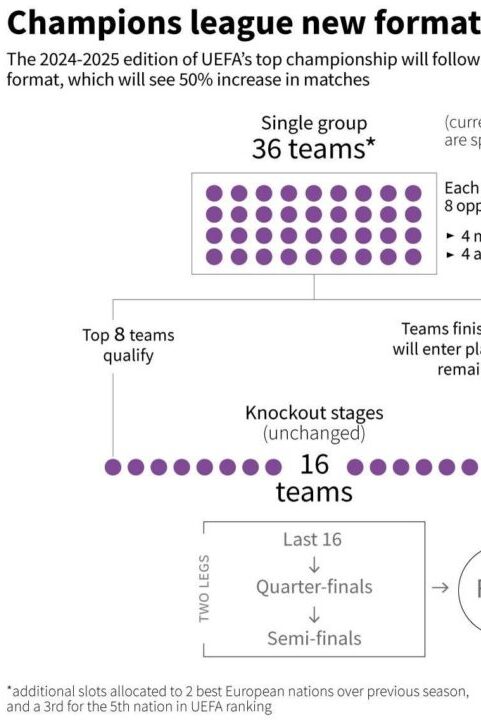
To understand the playoffs, we must first understand the ecosystem that creates them. Gone are the days of 32 teams split into eight isolated groups. UEFA has expanded the competition to 36 teams, all competing within a single, massive league table. Under this new Swiss Model, teams no longer play three opponents twice (home and away).
Instead, every qualified club plays eight matches against eight different opponents—four at home and four away. These fixtures are determined by seeding pots to ensure competitive balance, meaning top-tier teams will clash with other giants much earlier in the tournament. Points are tallied in a unified table, and this is where the drama begins.
Every goal scored and every point earned affects a team’s position in the table of 36. This universal ranking system is the engine that drives the new playoff format, turning matches that were once considered ‘dead rubbers’ into critical battles for seeding and survival.
The New Knockout Phase Play-offs Explained
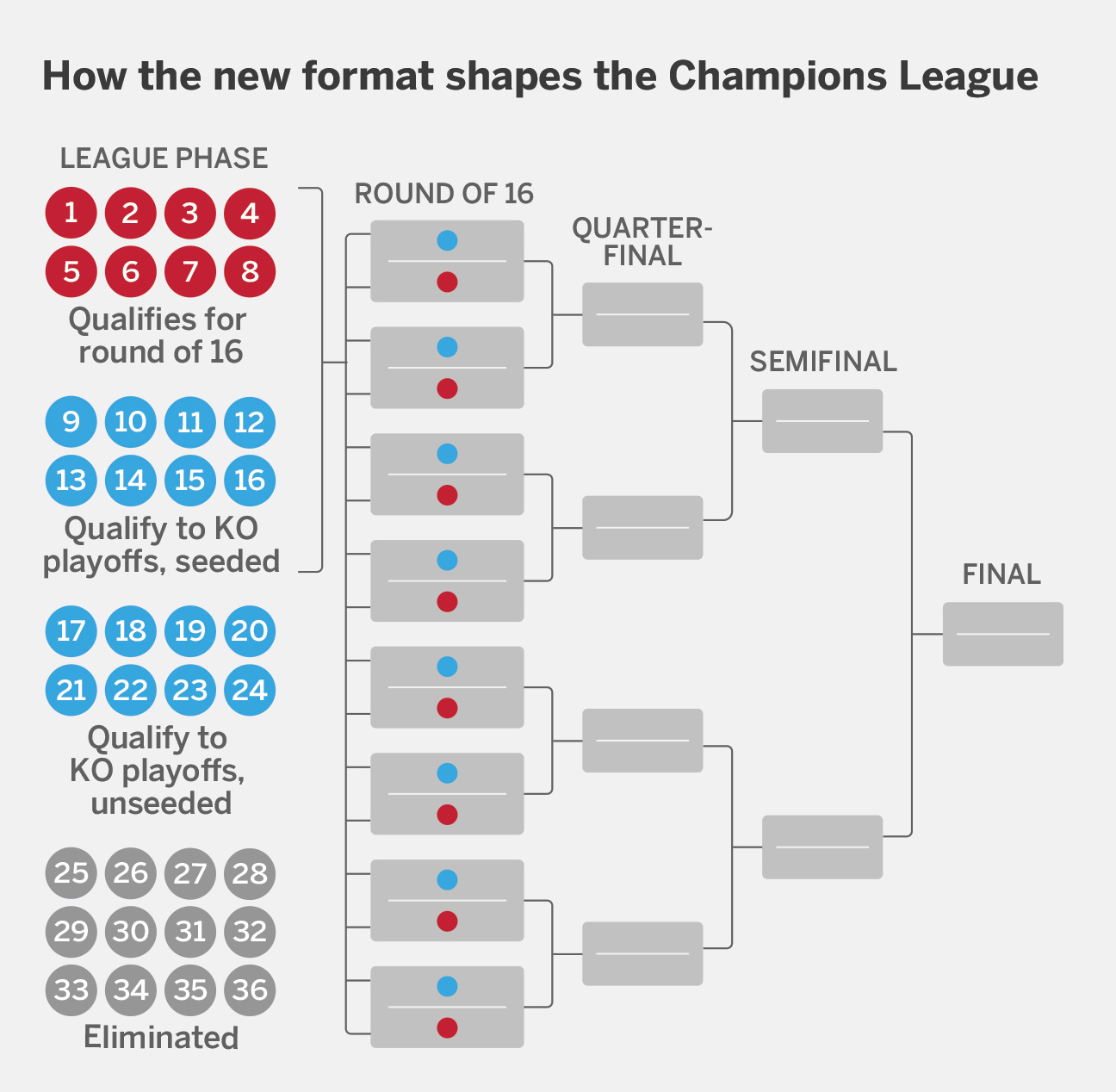
This is where the confusion often arises. In the old system, the top two teams from each group advanced to the Round of 16. In the new format, qualification is stratified based on final league position. The table is essentially divided into three distinct zones, each with vastly different fates.
1. The Elite Eight (Automatic Qualification)
The teams that finish in positions 1 through 8 in the league phase are the biggest winners of the new format. They bypass the new playoff round entirely and qualify directly for the Round of 16. Furthermore, they are seeded, meaning they will play the second leg of their Round of 16 tie at home—a significant tactical advantage.
2. The Battleground (Positions 9 to 24)
Here lies the most significant addition to the tournament structure: the Knockout Phase Play-offs. Teams finishing between 9th and 24th place must contest a two-legged tie to earn the right to join the top eight in the Round of 16.
This creates a fascinating dynamic. Teams finishing 9th to 16th are seeded and will face the unseeded teams finishing 17th to 24th. The seeded teams have the advantage of playing the second leg at home. This setup ensures that every single point in the league phase matters. The difference between finishing 8th (safe) and 9th (playoff danger) is monumental, just as the gap between 24th (survival) and 25th (elimination) is absolute.
3. The Drop Zone (Positions 25 to 36)
Strategic Implications for Managers and Squads
The introduction of the playoff round fundamentally alters how managers approach the season. In the past, a team could secure qualification after four or five group games and rest key players for the final match. That luxury has effectively evaporated.
With a single table, goal difference and total goals scored are likely to be the tiebreakers that decide whether a team finishes 8th or 9th. Managers will have to push for goals until the final whistle of the final matchday. A defensive approach to secure a 0-0 draw might be the difference between a rest week and a grueling two-legged playoff against a dangerous opponent.
Furthermore, squad depth will undergo a stress test like never before. The additional two games in the league phase, combined with the potential for two extra playoff games, means a team could play up to 17 matches to win the trophy, compared to the previous 13. Top clubs will need deeper rosters to rotate effectively without sacrificing results.
The Financial Windfall vs. Player Welfare
From a business perspective, the new format is a goldmine. More matches mean more broadcasting revenue, more gate receipts, and more commercial exposure. The ‘Knockout Phase Play-offs’ alone introduce 16 high-stakes matches that simply didn’t exist before. For mid-tier clubs that manage to squeeze into the 9-24 bracket, the revenue from these extra fixtures could be transformative.
However, this financial boost comes at a physical cost. The players’ unions and managers have long complained about fixture congestion, and this format exacerbates the issue. The play-offs take place in February, a time when domestic leagues are intensifying and cup competitions are in full swing. The risk of injury and burnout is higher, potentially favoring clubs with the financial muscle to hoard world-class talent on their bench.
Why the ‘Dead Rubber’ is Extinct
One of UEFA’s primary goals was to eliminate meaningless matches. In the old group stage, the final matchday often featured games between teams with nothing to play for. The new format solves this aggressively.
Imagine the final matchday of the League Phase. A team sitting in 23rd place needs a win to stay in the tournament. A team in 8th needs a win to avoid the playoffs. A team in 16th needs a win to secure a seeded spot in the playoffs. Almost every fixture will have direct consequences on the table, creating a synchronized night of drama across Europe.
Conclusion: A Necessary Evolution?
The changes to the Champions League format, particularly the introduction of the Knockout Phase Play-offs, represent a bold gamble by UEFA. They have traded the simplicity of the group stage for the complexity and volatility of a league table. While traditionalists may mourn the loss of the old structure, the potential for excitement is undeniable.
The new format punishes mediocrity and rewards consistency. It forces the giants of Europe to play each other sooner and removes the safety nets that allowed big teams to coast. The play-offs add a layer of jeopardy that will keep the tournament alive through the winter months, ensuring that the road to Munich, Wembley, or Paris is harder—and perhaps more prestigious—than ever before.

Anatoliy Trubin: The Ukrainian Wall Guarding Benfica’s Ambitions

Kings of Europe: Detailed Breakdown of Every Real Madrid UCL Fixture 2024/25

The Mourinho Effect: How He Revolutionized Champions League Football
About The Author
